
Research workflow tooling
New tools can emerge from unmet needs in researcher coordination, study operations, evidence capture, and day-to-day research support.
Products
EdTechLab builds products from real teaching, research, and delivery problems. Three of them make interactive learning content — interacty, intle, and EngagedLab — each starting from a different point. Sky is a different class of product: the operating system that turns an institution's active-learning baseline into a working, auditable system inside the VLE you already run.
Portfolio map
Parent lab
EdTechLab
Interactive content suite
Runs the baseline inside your VLE
The interactive content suite
interacty, intle, and EngagedLab all produce interactive learning that exports to SCORM and runs in your LMS, built with UK and EU compliance in mind. What separates them is where the work begins and how much the system does for you.
How the work gets made
From hands-on control to fully automated.
Scroll to move along the spectrum — the more you hand to the system, the deeper the pedagogy and analytics get.
01 · interacty
Build by hand
Assemble interactive blocks yourself in a secure studio. AI is opt-in, never required. Maximum control over content and learner data.
02 · intle
Describe it
Write a plain-English brief and intle generates a structured, interactive package in about 30 seconds, across nine formats.
03 · EngagedLab
Convert & analyse
Turn existing PDFs and slides into gamified labs aligned to Bloom's and RQF, with mastery analytics and grade passback for institutions.
SCORM export, every tool
Runs in your existing LMS
UK & EU compliance built in
Product · Build by hand
New on the front lineinteracty turns content into learning people can use.
A secure web studio for building interactive training, teaching, and engagement experiences. You assemble proven interactive blocks by hand, preview the whole learner flow, then export to SCORM or standalone HTML — with AI available only when you ask for it.
81
interactive blocks
412
style variants
SCORM 1.2 + 2004
or standalone HTML
EU-hosted
GDPR-ready by design
Blocks
Canvas
81 interactive blocks across 412 style variants — lessons, knowledge checks, timelines, galleries, flip cards, sorting tasks, 3D explainers, checklists, and call-to-actions, assembled the way you want them.
Generate a draft when it saves time, or build entirely by hand. Free accounts can create, edit, and export manually without spending on AI.
Data minimisation, EU-hosted core data, no ad trackers, private storage, revocable hosted links, and row-level access controls.
Download a SCORM package or standalone HTML for your own LMS, or host and live-deliver to a room via QR code on eligible plans.
How it works
01
Start
Pick a block, example, or template.
02
Edit
Adapt content manually, or generate with AI.
03
Review
Preview interactions, scoring, and learner flow.
04
Export
Download SCORM or standalone HTML.
05
Deliver
Upload to your LMS, or host and live-deliver.
Product · Describe it
Interactive learning content in about 30 seconds — up to 4,800x faster than a 40-hour build.
Describe the teaching or compliance need in plain English (and add a PDF, DOCX, or PPTX if you have one). intle detects the right format, generates the interactivity and feedback logic, and produces LMS-ready output — without weeks of manual authoring.
~30s
vs a 40-hour build
9
content formats
SCORM 2004 + 1.2
export to any LMS
WCAG 2.2 AA
accessible by default

intle reads your brief and picks the right shape — quiz, scenario, module, or assessment — so you do not have to configure templates first.
Quizzes, branching scenarios, modules, compliance training, presentations, assessments, workshops, and more — from a single description.
Natural-language edits such as "make this harder" or "add a regulation reference" update one section without rebuilding the whole package.
Mobile-native hosted links with no app install, or SCORM export, with logo and colour branding for L&D and compliance teams.
How teams use it
Describe the learning outcome, or upload source material.
intle proposes structure, generates activities, and opens a preview-first editor.
Publish a hosted link, or export SCORM for your institutional LMS.


Product · Convert & analyse
For UK higher educationTurn PDFs into interactive labs in about two minutes.
EngagedLab converts existing PDFs, slides, and lecture notes into gamified interactive labs aligned to Bloom's taxonomy and RQF levels — then tracks per-concept mastery across the cohort. Built for institutional review, not just content generation.
~2 min
per generated lab
4-8 hrs
saved per module
LTI 1.3
with AGS grade passback
WCAG 2.1 AA
accessible by default
A 30-second walkthrough: choose a source, generate the lab, inspect the structure, preview the learner experience, and export for LMS delivery.
Every objective is mapped to Bloom's taxonomy and RQF level, with scaffolded practice that progresses from guided to independent, and XP gamification to sustain momentum.
Graduated support — nudge, then clue, then scaffold — plus auto-generated micro-lessons when a misconception repeats across the cohort.
Per-concept mastery tracking, cohort-level misconception identification, and course coherence scoring — understanding, not just grades.
SCORM 1.2/2004 and LTI 1.3 with AGS grade passback, offline-ready packages, semester mapping, and Blackboard, Canvas, and Moodle compatibility.
Concept mastery distribution
Bayesian Knowledge Tracing places every learner on each concept across five states, so a lecturer can see where a cohort actually stands week over week.
Illustrative distribution for one concept across a cohort.
Built for

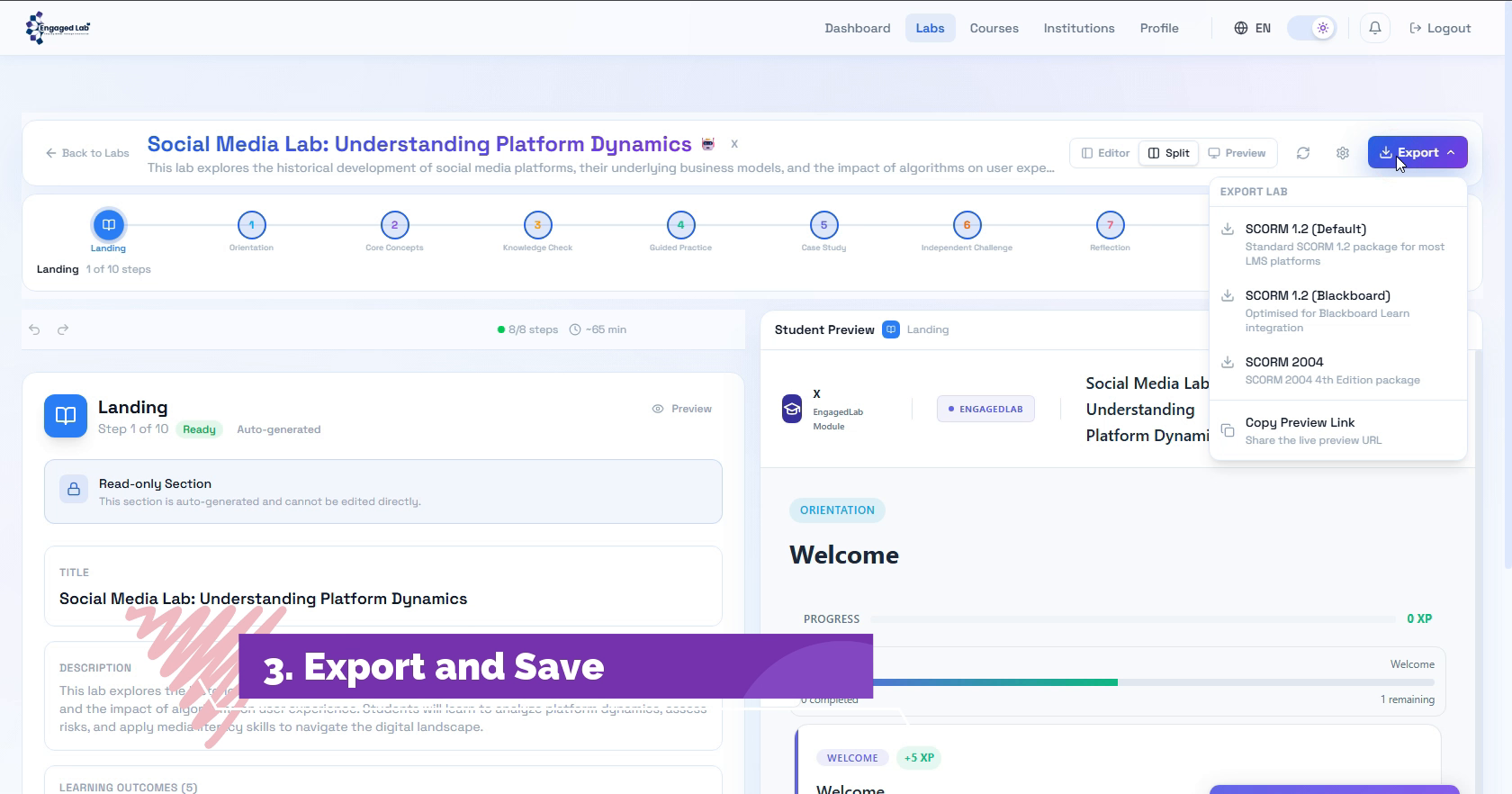

From guided source upload, to a structured editor with export, to the student-facing lab.
Which one fits?
Pick by how you want the work to begin and how much you want the system to decide. Many teams use more than one.
Swipe to compare →
| 01 · Build interacty | 02 · Describe intle | 03 · Convert EngagedLab | |
|---|---|---|---|
| Where you start | Interactive blocks you assemble by hand | A plain-English brief (plus optional files) | Your existing PDFs, slides, and notes |
| How much AI | Opt-in — never required | AI-first — generates the package | AI plus a pedagogy & analytics engine |
| Signature strength | Hands-on control and learner-data sovereignty | 30-second, multi-format generation | Bloom's/RQF alignment and mastery analytics |
| Export & delivery | SCORM 1.2/2004 + standalone HTML | SCORM 2004/1.2 + hosted links | SCORM 1.2/2004 + LTI 1.3 grade passback |
| Best for | Authors who want control and compliance | L&D producing volume, fast | HE institutions that need evidence |
| interacty.co.uk → | intle.co.uk → | engagedlab.co.uk → |
Operating system · Runs the baseline
For UK higher educationThe active-education baseline operating system for UK higher education.
Sky turns Jisc Beyond Blended, Laurillard's ABC Learning Design, OfS B1/B2 expectations, and local AI and accessibility policy into a working, auditable system at module level. It installs into your existing VLE via LTI 1.3 — no rip-and-replace.
Where the suite makes the content, Sky defines what good looks like, runs the whole module, and proves it. That is why it sits apart from interacty, intle, and EngagedLab.
Layer 1
Module Canvas, ABC palette, Live Preview, Inline AI Co-pilot. The baseline as a default scaffold, not a checklist.
Layer 2
Analytics ingest, staff-approved nudges, and a student AI tutor with per-assessment guardrails. Act on signals inside the week.
Layer 3
Compliance Scoreboard, Audit Ledger, OfS B1/B2 Evidence Pack, and institutional Heat-Map. Evidence as a by-product.
SKY · EDU 201 Inclusive Pedagogy
Active week
Inclusive Practice in Context
Drag activities into the canvas. Evidence updates immediately.
Reading: UDL principles in HE
Acquisition · async · 20 min
Seminar: Inclusive case review
Discussion · in-person · 50 min
Formative quiz: UDL checklist
Practice · async · 10 min
AI draft ready · Tab to acceptLab pipeline
New tools can emerge from unmet needs in researcher coordination, study operations, evidence capture, and day-to-day research support.
Repeated analytics, reporting, or experiment-delivery problems can inform future products and reusable systems where the need proves consistent enough.
Collaboration with universities, institutions, and research teams can become the basis for future ventures when the problem is credible enough to deserve its own product.
Product philosophy
Products should solve a real research, learning, or operational problem before they ask for attention.
Privacy posture, accessibility expectations, and implementation quality are treated as design requirements rather than late-stage additions.
Good product design should make evidence, interpretation, and learning loops stronger rather than leaving analytics as an afterthought.
Each product should be able to grow into a broader system rather than collapsing under its first successful use case.
Discuss a product idea