Workflow systems
Study setup, operational tooling, and delivery systems for structured programmes
Designed to reduce coordination overhead across research support, pilots, and institution-facing delivery.
Engineering the Future of Learning
Research, products, analytics, and delivery systems
EdTechLab is a UK education technology lab. We design researcher tools, workflow systems, learning analytics, pilot infrastructure, and public products such as EngagedLab for universities, institutions, researchers, and education teams.
Workflow systems
Study setup, operational tooling, and delivery systems for structured programmes
Designed to reduce coordination overhead across research support, pilots, and institution-facing delivery.
Analytics systems
Evidence-ready event capture, reporting, and decision support that turn activity into usable insight.
Product portfolio
EngagedLab is one product inside a wider EdTechLab model built to support repeated use, iteration, and future portfolio growth.
Research focus
What we do
We combine research-aware product thinking, careful engineering, analytics design, and operational clarity so teams can move from important questions to usable systems and products.
Lab core
EdTechLab
01
Researcher tooling
02
Experiment infra
03
Learning analytics
04
Responsible AI
05
Product R&D
01 · Researcher tooling
Workflow systems that reduce coordination overhead around study setup and evidence capture.
02 · Experiment infrastructure
Digital environments where pilots, prototypes, and research-led programmes can run with discipline.
03 · Learning analytics
Event models, pipelines and dashboards that make findings easier to trust and act on.
04 · Responsible AI
AI applied where it improves clarity, speed and quality while keeping oversight and judgment in place.
05 · Product R&D
Repeated operational and educational problems become products like interacty, intle, EngagedLab and Sky.
The interactive content suite
interacty, intle, and EngagedLab all export to SCORM and run inside your existing LMS — what changes is how the work gets made, from hands-on authoring to fully automated conversion. Sky ties them into a baseline operating system for UK higher education.
A no-code studio to assemble interactive content by hand, then export to SCORM or standalone HTML.
81 blocks · 412 variants
Write a plain-English brief and intle generates a structured, interactive SCORM package across nine formats.
~30s · up to 4,800× faster
Turn PDFs and slides into gamified labs aligned to Bloom's, with mastery analytics and LTI 1.3 grade passback.
PDFs → labs in ~2 min
The active-education baseline operating system for UK higher education, installed into your existing VLE.
Installs via LTI 1.3
SCORM 1.2 / 2004 export · LTI 1.3 grade passback · UK & EU compliance built in · deployed in Blackboard
Explore the product suitePrinciples, not promises
Research is complex, institutions are different, and technology is only one layer of the outcome. What EdTechLab commits to is research-aware engineering, transparent communication, careful analytics design, and delivery choices that make future evaluation easier rather than harder.
What we will do
Scope clearly, describe tradeoffs honestly, and build around the operational reality of the team using the system.
What we will not do
Hide uncertainty behind inflated language, overstate deployment maturity, or claim evidence that does not yet exist.
Company model
EdTechLab is the parent company and operating platform. Research support, analytics, workflow systems, pilots, and product development all sit inside that structure. EngagedLab is the first public product, not the whole company.
Research support is one major strand
Research-aware delivery matters, but it sits alongside products, analytics, workflow systems, and institution-facing implementation.
Analytics that support decisions
Research teams need evidence systems that reveal signal, protect context, and support interpretation rather than defaulting to coarse reporting.
Workflow support and delivery systems
Good tooling helps teams spend less time chasing process and more time on outcomes, implementation, and measurable improvement.
A portfolio built from real problems
EdTechLab is structured to turn repeated research and operational needs into reusable products and platforms when the problem justifies it.
Who we support
We are most useful where learning context, experimental rigor, analytics quality, and product usability all need to hold together.
Research centres, digital learning teams, and institutional programmes that need better tools around pilots, evaluation, or product innovation.
Organisations improving education-facing services, research operations, or evidence workflows without settling for generic software patterns.
People who need technology that improves data quality, lowers operational friction, and supports better experiments and analysis.
Cross-functional groups running studies, pilots, or innovation work that need better coordination, clearer analytics, and more usable digital support.
Audience-specific view
The same EdTechLab offer looks different depending on whether you are protecting institutional standards, delivering a study, running a pilot, or evaluating EngagedLab as a product.
Research context
Universities
Digital learning teams
Need
Research-ready infrastructure without vendor sprawl.
Institutions
Innovation & evidence teams
Need
A route from pilot to platform before procurement.
Research teams
Pilots, studies & innovation
Need
Clearer coordination, analytics, and usable support.
Researchers
PIs, leads & delivery owners
Need
Tech shaped around study design, not defaults.
Research-ready infrastructure without enterprise-vendor sprawl.
For university digital teamsA route from pilot to platform before large procurement decisions.
For institutional innovation teamsBetter coordination, clearer analytics, and usable digital support.
For research teamsTechnology shaped around study design, not generic platform defaults.
For research leads & PIsWhy EdTechLab
We work close to the problem, careful with evidence, and deliberate about what becomes a system, a workflow improvement, or a product.
Data structure, experimental quality, and operational constraints are addressed in the design phase rather than patched in after launch.
Research tooling only creates value when people can trust it, understand it, and fit it into existing workflows.
We use AI where it improves clarity, workflow speed, or support quality without eroding oversight, context, or research judgment.
Systems are designed to grow with a research programme, handling new requirements without structural rework.
Company FAQ
Research support is a major part of what we do, but not the whole company. EdTechLab also works across analytics systems, pilot infrastructure, workflow tooling, responsible AI support, and product development.
EdTechLab is led by founder Sara Jasouli.
EngagedLab is one of three live products in the EdTechLab interactive content suite, alongside interacty and intle, with Sky as the baseline operating system. It sits inside the wider lab, alongside capability work in workflow systems, analytics, and education technology infrastructure.
Yes. EngagedLab has a live public product site, and the EdTechLab website now includes a walkthrough video, screenshots, and an internal case study showing the current creation and export flow.
EdTechLab operates as an independent education technology lab with a live public website, published Lab Notes, and a public EngagedLab product presence.
We work on researcher tooling, study workflows, experiment platforms, analytics systems, reporting layers, delivery environments, and product platforms designed for educational use in research and institutional settings.
Yes. A common part of the work is fitting new capability into real operational contexts instead of forcing a team to start again from a blank slate.
Lab case study
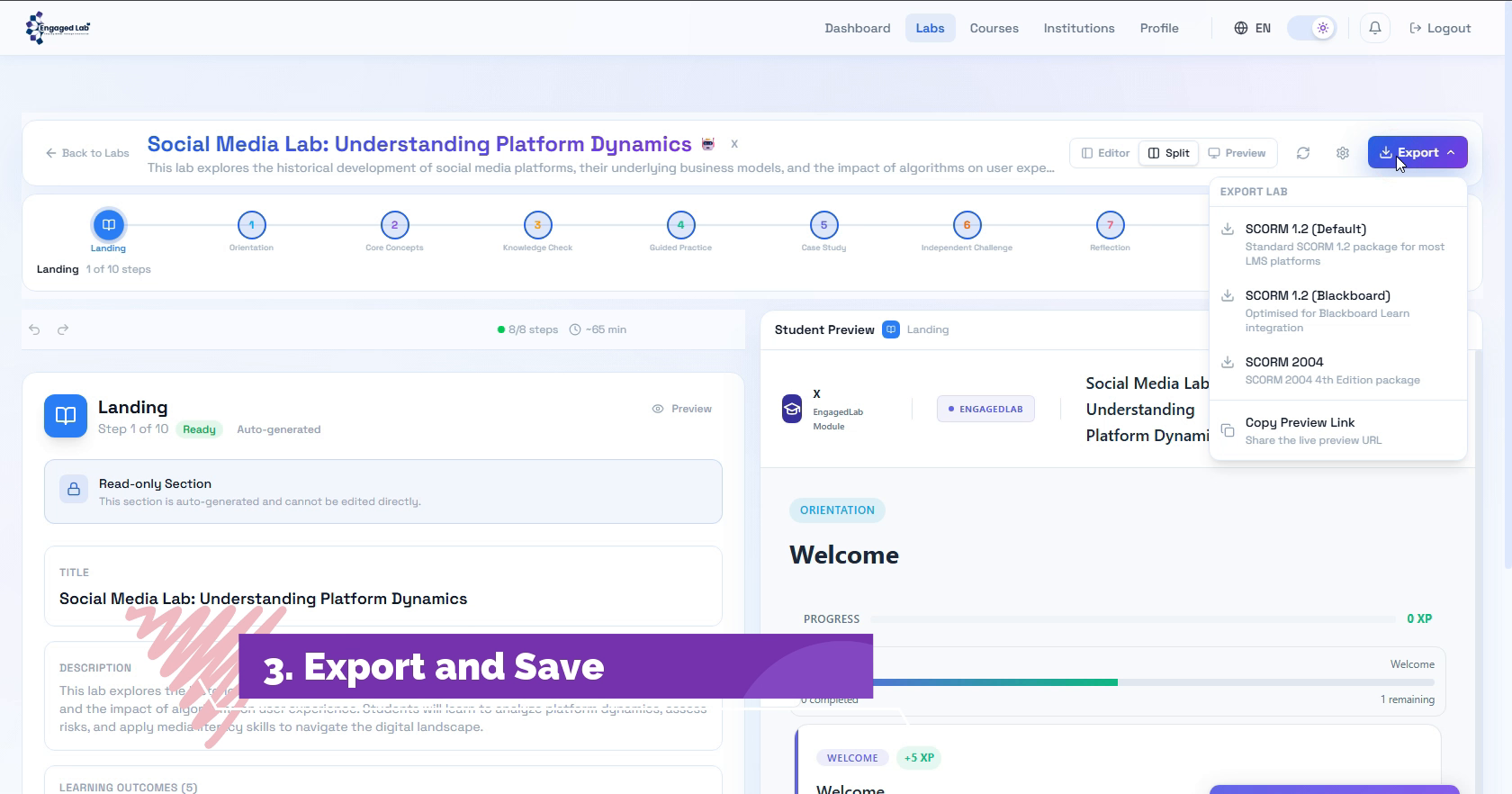
The current EngagedLab case study documents a visible create-to-preview/export path: source upload, generated lab structure, student preview, SCORM export, and a Blackboard-oriented handoff workflow.
Demo pace
~30 sec
Current create-to-preview/export walkthrough.
Workflow
8 steps
Visible in the walkthrough overlays from generation to live preview.
Delivery path
SCORM + LMS
SCORM 1.2, SCORM 2004, and Blackboard-oriented setup are visible today.
Research frame
The case-study framing is grounded in high-impact active-learning literature and current analytics guidance. The product is being shaped around a simple standard: make interaction easier to build, easier to preview, and easier to move into institutional delivery than a passive upload-only workflow.
From Lab Notes
One evidence lens, three notes
Evaluate
Infrastructure
Model
Analytics quality
Design
Adoption paths
Evaluate
Infrastructure readiness.
Model
Analytics quality.
Design
Product adoption paths.
A practical evaluation framework for teams reviewing study-design fit, evidence quality, governance, accessibility, and interoperability before treating a platform as ready.
Key idea
Review the event model, governance, and operational fit underneath the demo.
Use case
Useful for digital teams, procurement review, and infrastructure decisions.
Product-quality design
Why usability and accessibility change evidence quality in research settings.
Analytics architecture
Why late analytics design makes data harder to trust, compare, and govern.
Next step
We welcome thoughtful conversations about workflow systems, pilots, analytics, institutional implementation, EngagedLab, and broader education technology innovation.